Understanding Engagement Rings
Deciding on the style of your gold engagement ring can be confusing when there is a great variety of diamond shapes and ring styles you can choose from. But no worries! Eternate’s Engagement Ring Guide is here to provide you with a simple yet effective guide on how to choose your ring. From the characteristics of each diamond shape and the details of setting styles to alternative engagement rings, you can find the essential information needed for choosing (and customizing!) the perfect engagement ring to pop the question with!
1. Design Styles
-

Solitaire
Solitaire is the first image that pops into mind when thinking about engagement rings. It is iconic, featured in almost all famous romantic movies, symbolizing eternal love and the bond between couples with a single diamond. Solitaire rings have this simple yet impressive elegance. Although the most popular diamond shapes are round and princess for this design, it can support any other choice of shape, offering a great deal of customization. You can find 4 and 6 prong settings in solitaire designs where the cradle of the diamond has 4 or 6 metal clamps that hold the diamond.
-

Pavé
For those who love endless sparkle, the pavé style features a band lined with closely set diamonds that create a continuous shimmer from every angle. Elegant, timeless, and highly versatile, pavé settings beautifully enhance the brilliance of your center stone while adding a luxurious touch to your engagement ring.
-

Halo
Halo engagement rings scream “I love you” in stones! They feature a row of small diamonds surrounding the center stone. Though, nobody said that it couldn't be two rows. Any diamond shape you choose will radiate more, stand out more, and impress more with a halo around them. You can say that this design is less customizable than the others; nevertheless, it's one of the most astonishing.
-

Cluster
Cluster designs make the most exquisite rings with the composition of several bigger stones. You can choose your cluster ring similar to a halo ring with larger stones surrounding the central stone or go for the asymmetrical aesthetic that this design effortlessly provides. Either way, your cluster engagement ring is sure to be elegantly whimsical and brilliantly attractive.
-

Cathedral
The elegant frame of this design resembles the cathedral as two couples of arches stem from the band and settle on either side of the diamond. The cathedral engagement ring creates a stunning effect while elevating the center stone and making it more prominent. You can customize a cathedral engagement ring by adding more stones, choosing different metals or playing with colors. It will preserve its elegance and make a unique choice to celebrate your unique story.


2.Setting Styles
-

Claw Setting
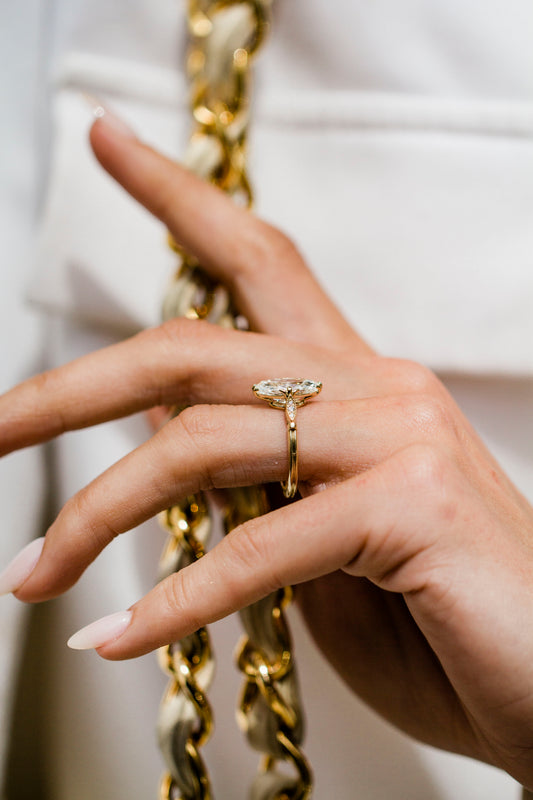
A claw setting is the most common alternative for center stones, securing your center stone with metal clamps. As its name states, this setting features sharp curved nails like a bird's claw. Different shapes of diamonds require different numbers of claws. Typically a round diamond will be set in 4-claw or 6-claw; square and rectangular diamond shapes such as princess will require four, while other cuts like marquise and pear will require V-shaped claws to protect the pointy diamond.
-

Prong Setting
The prong setting is very similar to the claw setting. It secures the stone to the ring's band and appears round or pointed, looking like pins on the diamond rather than claws. Prong settings can be 'shared' or 'high' based on preference.
-

Micro Pave Setting
The technique that aims to show the least amount of metal on the ring and create a gorgeous sparkly band while securing gemstones.
-

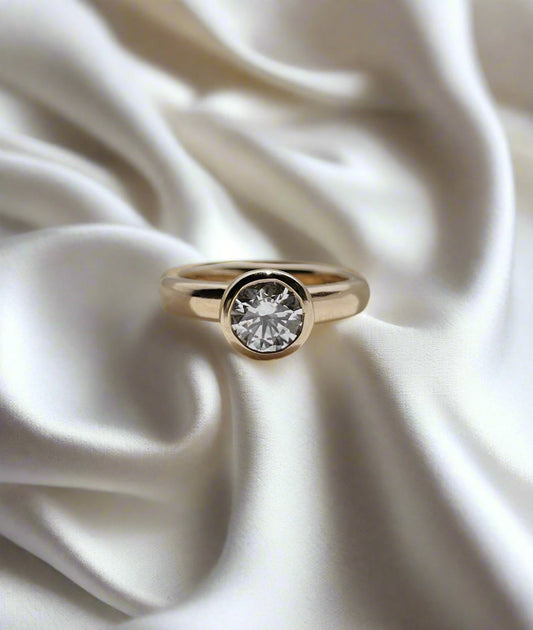
Bezel Setting
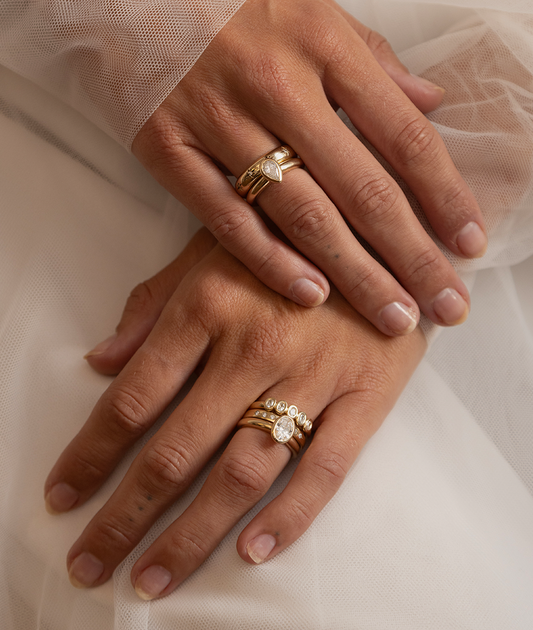
The technique where a thin metal rim surrounds the stone and binds it to the ring. It looks like a diamond engraved into the ring's band. Though subtle and beautiful, we should warn you that this setting hides more of your stone compared to the other settings.
-

Channel Setting
Namely, this technique is about a channel sculpted in the band of your ring where stones lie. Stones sit side by side in this channel, secured and ready to take your breath away.


3. The Anatomy of the Diamond
Let's get to know the anatomy of the diamond before we move on to different shapes of diamonds:

Table: A diamond’s largest facet.
Crown: The part of the diamond that extends from the girdle to the table.
Girdle: The rim that separates the crown from the pavilion. The girdle is where a diamond is held while setting it in jewelry.
Diameter: The measurement from the girdle, the widest horizontal line surrounding the diamond.
Pavilion: The part of the diamond that extends from the girdle to the culet.
Culet: The tip of a gemstone. An untrained eye should not be able to see the culet.
Depth: The measurement from the culet to the table, the highest vertical line on the diamond.
Metals
At Jenifer Maison, we combine our 60 years’ experience with modern die-making techniques to create a non-porous, tensile metal property with excellent surface quality. To achieve their stunning color and shine, we purify and mix all metals and alloys used in our processes. Whichever metal you choose, rest assured that our exclusive in-house knowledge results in exquisite and durable jewelry with not only great designs but also the longest life.
We are committed to sustainability. Therefore we use 100% recycled gold in all Eternate products. Gold is a soft metal, which needs other metals to be added to it for strength and different complexions of colors. The word ‘karats’ refers to the amount of gold content in the jewelry. Do not confuse it with ‘carats’, which is the measurement unit for diamond weight. At Jenifer Maison, we offer three options of gold karats: 18K, 14K, and 10k, each containing 75%, 58.5% and 41.7% of gold, respectively.
-

Yellow Gold
A classic and timeless color. Yellow gold is never a dull choice; it never goes out of fashion.
-

Rose Gold
Soft and romantic. Yellow gold and copper blend together to get that beautiful, rosy pink complexion.
-

White Gold
A noble tone. The blend of yellow gold with zinc, nickel and other metals appears in this white complexion.
-

White Gold
A noble tone. The blend of yellow gold with zinc, nickel and other metals appears in this white complexion.


Moissanite Engagement Rings
-
Pear Bezel Solitaire Engagement Ring – 0.5 CT Moissanite Diamond
Regular price From €1.516,95 EURRegular price -
Round Solitaire Bezel Engagement Ring – 1 CT Moissanite Diamond
Regular price From €1.543,95 EURRegular price -
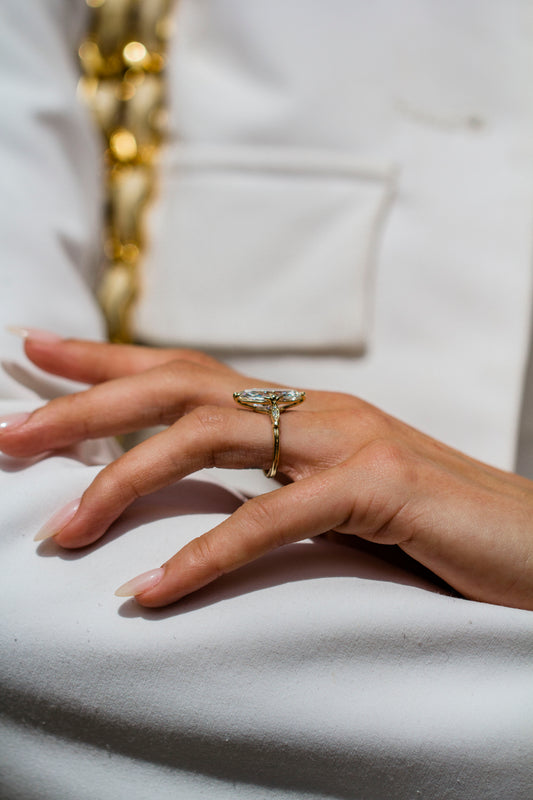
Marquise Solitaire Engagement Ring – 5.03 CT Moissanite Diamond
Regular price From €1.760,95 EURRegular price -
Moval Solitaire Engagement Ring – 2.8 CT Moissanite Diamond
Regular price From €1.624,95 EURRegular price